
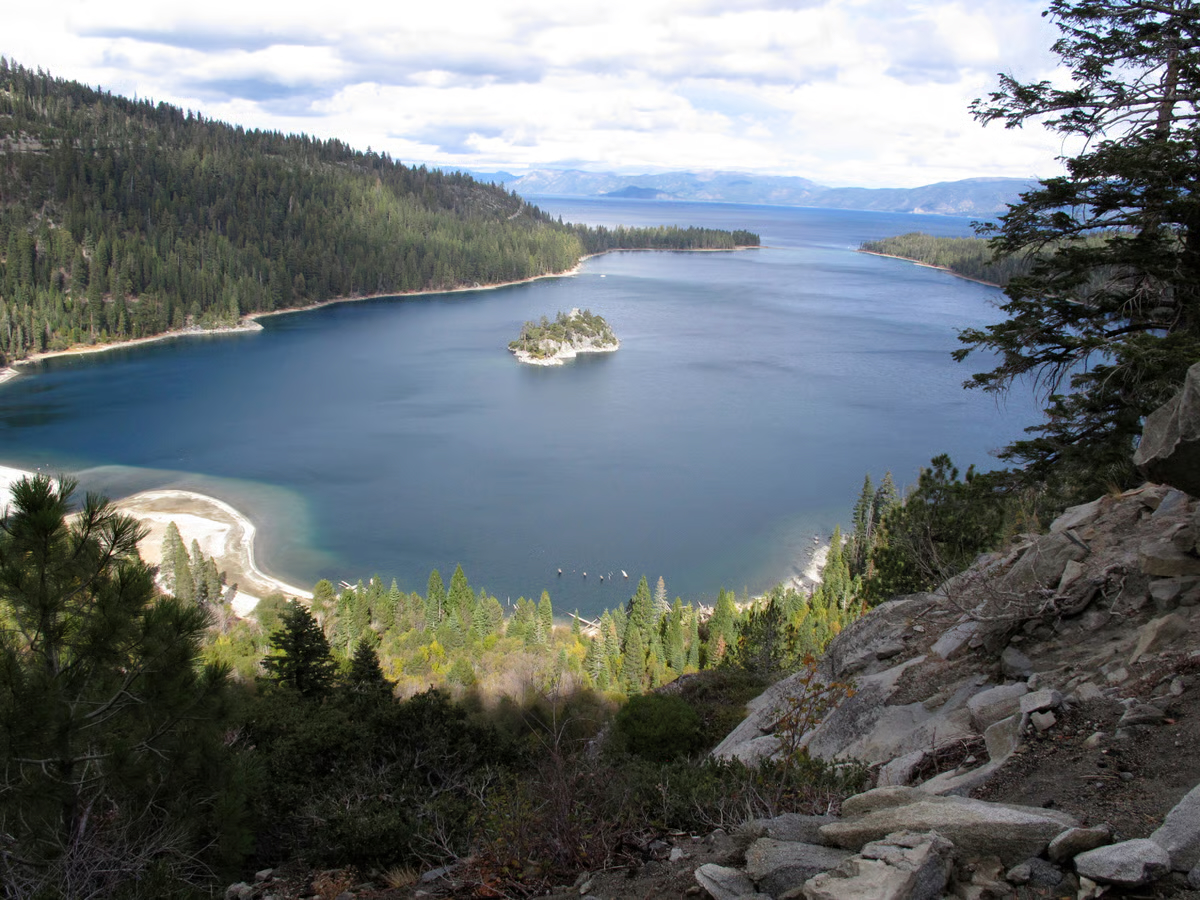
About 49,000 households on the California side of Lake Tahoe are having a conversation most of us never have to. Their utility, Liberty Utilities, isn't connected to California's electrical grid at all. Every kilowatt-hour they use is bought from Nevada — most of it from NV Energy, under an agreement that started as a temporary fix in 2009 and has been extended ever since.
That agreement runs out. CapRadio reported in early August that the California Public Utilities Commission has approved Liberty's search for a new supplier, with bids this year, a decision expected in 2027, and a transition in 2028.
South Lake Tahoe's mayor described the initial reaction to the news as "panic, like 'oh man, the lights are going out.'"
The lights are not going out. But there's something in this story worth paying attention to even if you live four hundred miles away.
Who they're bidding against
Northern Nevada currently has more than 40 data center projects underway. NV Energy's 2024 long-range plan lays out a dozen of them specifically. Fortune reported in May that data centers already consumed roughly 22% of Nevada's electricity in 2024, and are projected to hit about 35% by 2030.
So when 49,000 households go shopping for a power supply in that market, they are shopping in the same aisle as some of the best-capitalized companies on earth, who need enormous amounts of firm power and are not especially price-sensitive.
That's the part that generalizes. It is happening in Virginia, in Texas, in Ohio, and increasingly in the West. Household demand for electricity has been basically flat for twenty years. Data center demand is not flat, and the two are drawing from the same pool.
The bill was already going up
Liberty's customers weren't in a comfortable position going in. CapRadio put their residential rates in the range of 41 to 46 cents per kilowatt-hour — well above the rest of the state. Liberty is also separately seeking to recover about $78 million in costs tied to the 2020 Mountain View Fire, and its wildfire insurance costs have risen from under $8 million authorized to a forecast north of $31 million.
For everyone else in California, the trend is the same, just less dramatic. The CPUC's Public Advocates Office publishes a quarterly rate report, and its most recent one puts average residential rates as of June 2026 at about 33.7 cents for PG&E, 34.4 cents for SCE, and 45.5 cents for SDG&E. Over the last ten years those rates rose 69%, 101%, and 97% respectively. Inflation over the same stretch was around 42%.
None of that was voted on by any of the people paying it.
And the grid itself is having a rougher decade
The Energy Information Administration tracks how long the average American customer spends without power. In 2024 it was about 11 hours, across an average of 1.5 separate interruptions — the worst figure in ten years, driven mostly by major storms.
California adds its own category. Liberty de-energized about 1,491 customers in Alpine and Mono counties for roughly 17 and a half hours during a wind event in November 2024. And in Southern California Edison's report on a June 2025 public safety power shutoff, restoration times across the affected circuits ranged from about half a day to — on one circuit — close to twelve days.
Twelve days is not a candle-and-flashlight situation. That's a refrigerator, a well pump, a CPAP machine, and a work-from-home job.
What you can actually control
You don't get a vote on your utility's supply contract. You don't get a vote on what a data center in the next state is willing to pay for power, or on how much your utility spends on wildfire insurance.
What you do get to decide is how much of your electricity you make on your own roof, and whether you can store any of it.
We should be honest about the limits of that, because plenty of people selling solar aren't:
- Solar doesn't disconnect you from the utility. Almost every home system is grid-tied. You'll still have a bill, and you'll still pay the fixed monthly charges that come with having a meter.
- Solar alone does not keep your lights on in a blackout. For safety reasons, a grid-tied system shuts down when the grid goes down, so it can't send power onto lines a repair crew may be touching. Backup requires a battery — that's a separate purchase and a separate conversation.
- What solar does change is the part of the bill that scales with usage. In a state where the per-kilowatt-hour price has doubled in a decade, that's the part worth fixing.
The households around Lake Tahoe are getting a very direct lesson in something the rest of us can ignore for a while longer: the price of your power is set by negotiations you're not in, between parties who don't know your name.
The short version
Your electricity comes from a contract somebody else signed. That contract is being renegotiated all over the country right now, against demand that didn't exist five years ago. You can't change the terms — but you can change how much of the outcome you're exposed to.
GRID doesn't sell solar to homeowners — GRIDcard connects homeowners with verified local solar pros who show their math.